
Letters of Conscience
In an age when truth trembles beneath the weight of noise, we return to the language of conscience — to the measured cadence of thought that once shaped a nation. These letters are written in the spirit of our Founding Fathers, not as echoes of a distant past, but as instruments of renewal. Each letter carries a lesson forged in the fires of revolution and tempered by reason, calling us to examine the soul of our Republic anew. Here, history does not whisper — it instructs. And through these reflections, we summon the courage to act with virtue in an unvirtuous age.
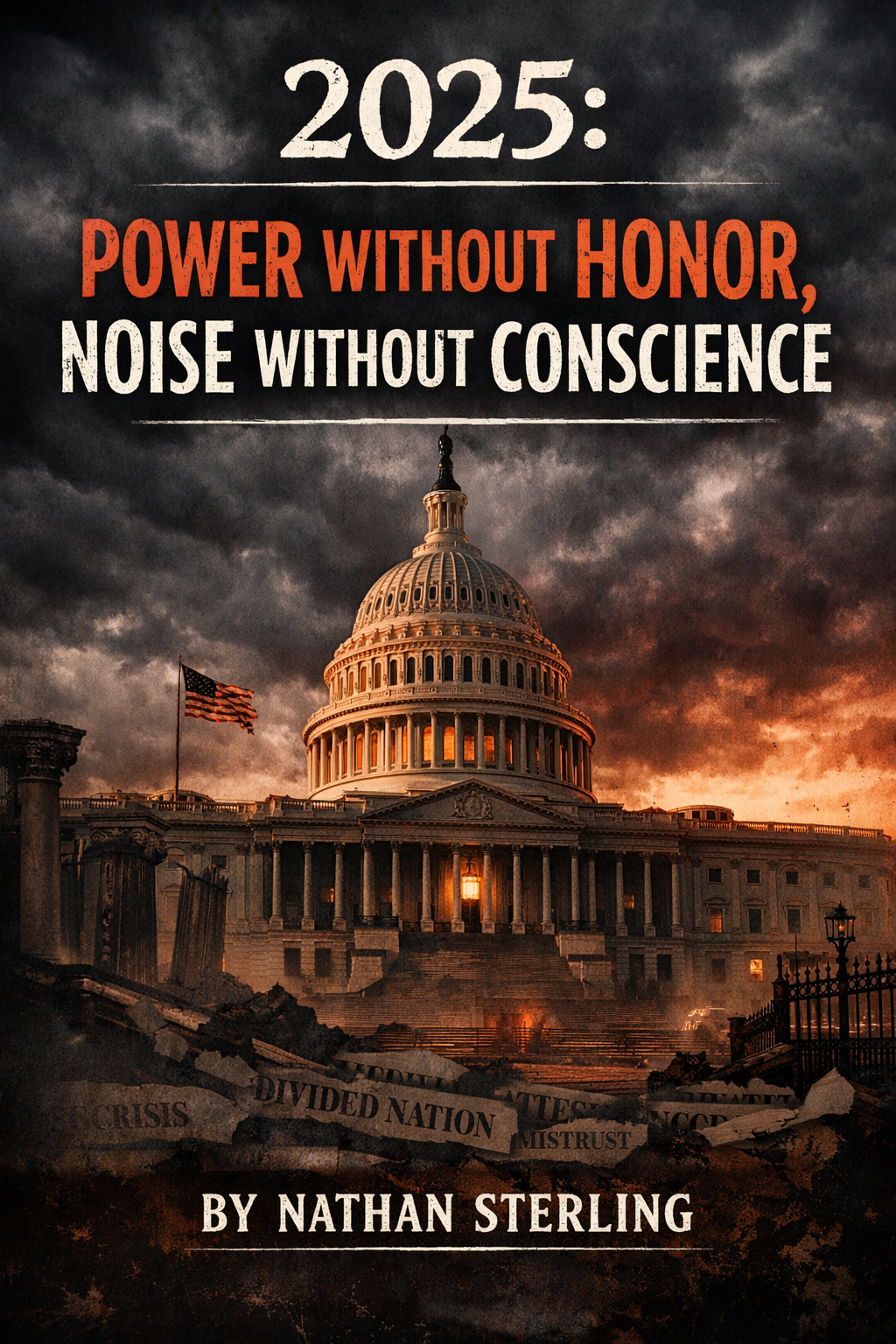
2025: A Year Loud With Power, Quiet on Conscience
2025 will not be remembered for what it broke, but for what it refused to fix. This was a year defined by evasion—where power was exercised loudly and conscience quietly set aside. Outrage became a business model, truth a political instrument, and governance an afterthought. I watched leaders on every side master the performance of indignation while neglecting the responsibility of stewardship. This essay is not written to flatter factions or soothe tempers, but to confront an uncomfortable reality: a republic cannot endure on noise alone.

Weaponized Truth Is Still a Lie
Washington tells the truth every day—and almost never honestly.
Democrats and Republicans both wield real facts as weapons, not tools. Charts become indictments. Statistics become shields. And the moment the facts are deployed, responsibility vanishes.
Weaponized truth is still a lie. When facts are used only to blame the opposition and excuse oneself, governance stops and the Republic pays the price.
Extremes Don’t Govern. They Profit.
The far left and the far right speak as enemies, but operate as partners—each dependent on the other’s excess to justify outrage, fundraising, and relevance. They do not seek to repair what is broken. They seek to monetize it.
Extremism thrives on noise, not results. Outrage is the business model. Governing is the casualty. And as long as the loudest microphones belong to those who profit from dysfunction, the work of the Republic will remain unfinished.
Moderation is not weakness. It is work. It requires judgment, restraint, and the willingness to endure criticism in service of stability. That discipline—more than any slogan—is what keeps republics alive.

The Duty to Govern: When Soapboxes Replace Statesmanship
For forty days, the Republic stood still — its doors closed, its workers unpaid, its leaders entangled in a performance of pride. In Letters of Conscience No. VII – The Duty to Govern, Nathan Sterling reflects on how both parties failed their duty to serve and honors the senators who finally crossed the aisle to reopen America’s government. A Hamiltonian appeal to humility, reason, and the forgotten art of governing over grandstanding.

A Republic That Forgets to Feed Itself
When pride becomes policy, the Republic goes hungry. Forty-two million Americans now face lost food assistance — not from scarcity, but from political vanity. In Letters of Conscience No. VI – A Republic That Forgets to Feed Itself, Nathan Sterling channels the wit of Benjamin Franklin to remind today’s leaders that compassion delayed is compassion denied — and that no Republic built to serve its people can survive if it forgets to feed them first.

The Hypocrisy of Hostage Politics: When Power Forgets Principle
When those who once condemned “hostage politics” now wield it for power, the Republic stands betrayed by hypocrisy. Nathan Sterling calls Americans to remember that conscience — not control — is the foundation of self-government.